Why Data Linkage Needs a Community: How Collaboration is Shaping Innovation in the Data Linkage Hub
Innovation always benefits from strong communities that connect practitioners across the NHS, government, academia and research institutions. This article explores how DARE UK-funded communities such as ITALO, SPRINT and the UK Data Linkage Community are helping to advance data linkage quality, public engagement and methodological innovation, and how the NHS England Data Linkage Hub is translating this collaboration into practical tools such as the Pre-Linkage Report and new approaches to transparent, trustworthy data linkage.
One of the most valuable aspects of working in data science is that innovation rarely happens in isolation. Some of the most significant advances emerge when people from different organisations, disciplines and sectors come together to tackle shared challenges. The NHS England Data Science & Applied AI team has long recognised this through its PhD internship programme. Over the years, the programme has brought talented and curious researchers into the heart of the NHS, giving them the opportunity to work with real-world healthcare data while building lasting connections between academia and the public sector. The Data Linkage Hub was fortunate to benefit from this programme last year through a fantastic PhD intern. While the internship itself has now concluded, the knowledge exchange and collaboration that it initiated continue today. In many ways, that experience reflects a broader truth about data linkage: the most valuable outcomes often come not from individual projects, but from the communities that grow around them.
A Community Beyond Organisational Boundaries
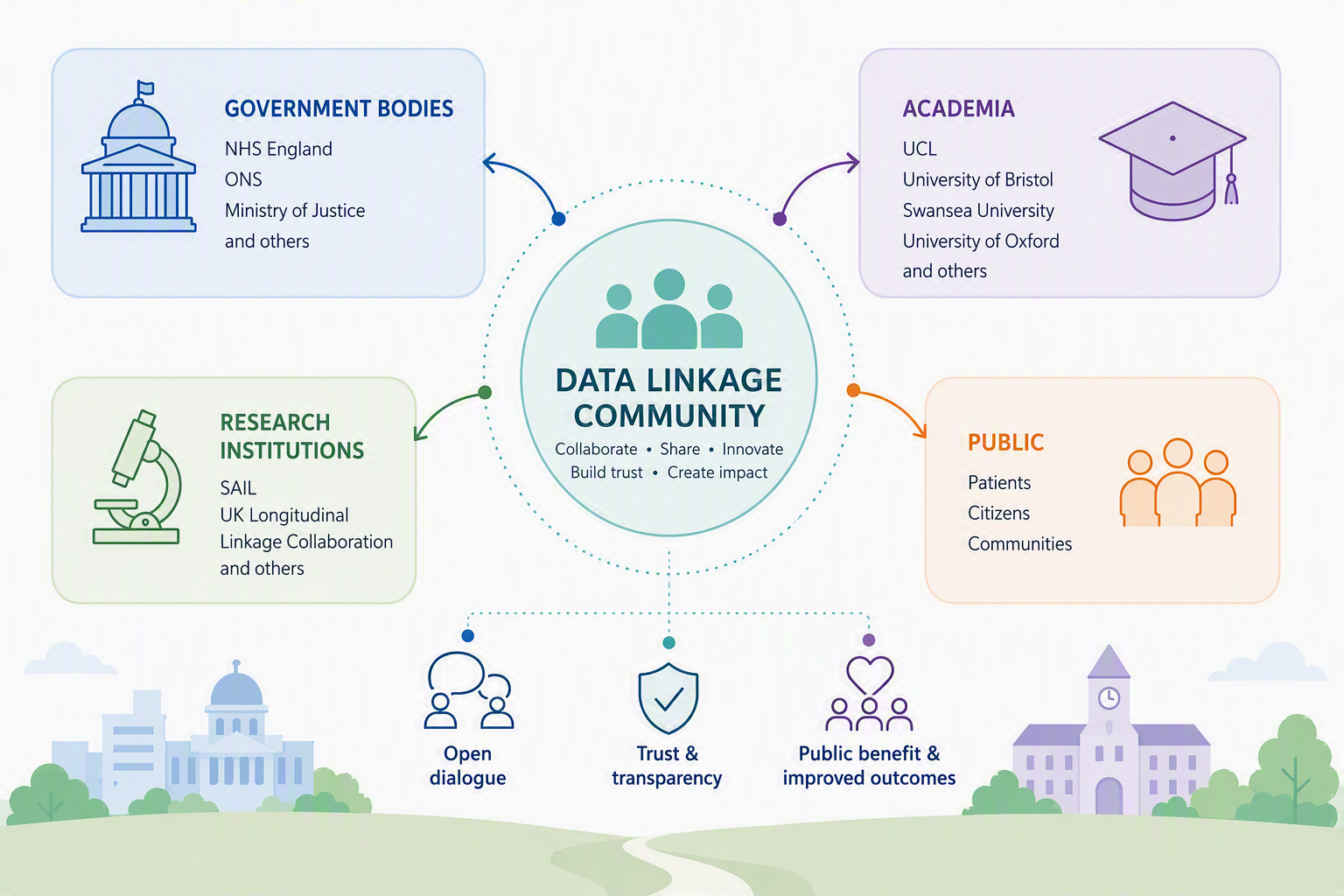
The UK has a vibrant and highly collaborative data linkage community. Expertise is distributed across a diverse range of organisations, including public-sector bodies such as NHS England, the Office for National Statistics (ONS) and the Ministry of Justice (MoJ), as well as academic institutions including University College London, the University of Bristol, Swansea University and the University of Oxford. Important contributions also come from research organisations such as SAIL (Secure Anonymised Information Linkage) and UK Longitudinal Linkage Collaboration (UK LLC). Although these organisations have different objectives and priorities, they often face many of the same questions: • How can we establish a common language when discussing data linkage quality? • How can we involve the public in meaningful conversations about data linkage and its implications? • How can we support learning, capability development and knowledge sharing across the field? These are important challenges, but they are also difficult for any single organisation to solve alone.
Creating Space for Collective Innovation
This is where community-led collaboration becomes invaluable. Through funding and support from DARE UK, communities of interest have emerged that provide dedicated forums for discussion, experimentation and knowledge exchange across organisational boundaries. Initiatives such as ITALO (Improving Transparency Around Linkage Outputs), SPRINT (Single Patient Record Integrity, Trust and Transparency) and the UK Data Linkage Community bring together practitioners, researchers and policymakers to share experiences, develop new approaches and collectively respond to common challenges. These communities are co-chaired and supported by individuals from across government, healthcare, academia and research institutions, creating a unique environment where ideas can move rapidly between theory and practice. The value of this collaboration extends beyond networking. It enables organisations to collectively invest in activities that are often important but difficult to prioritise locally, such as methodological research, standards development, public engagement and capability building. For smaller teams especially, participation in these communities provides access to expertise, innovation and experimentation that would otherwise be difficult to resource independently.
Making the public voice part of the story
Knowledge exchange is particularly important when discussing complex topics such as data linkage with members of the public. Earlier this year, I had the opportunity to present at a PEDRI webinar, highlighting how sharing methods, terminology and practical experience across organisations can help improve public understanding of data linkage and strengthen conversations about trust, transparency and the use of data for public benefit. A particularly powerful example of this approach is the work undertaken by Dr Joseph Lam through The Link Lab's interactive game, which helps explain record linkage concepts in an engaging and accessible way. By translating complex methodological concepts into practical experiences, tools such as The Linkmaster's Dilemma help bridge the gap between technical specialists and wider audiences, supporting more informed and meaningful public engagement. These activities demonstrate that communities of practice are not only advancing methodology; they are also helping make data linkage more understandable, accessible and trustworthy.
From Community Ideas to Operational Impact
The benefits of these collaborations are already finding their way into operational delivery within the Data Linkage Hub. One example is the Pre-Linkage Report, originally developed by Dr Joseph Lam as part of collaborative work emerging from the wider data linkage community. The Pre-Linkage Report is an automated data quality assessment tool designed to evaluate whether a person-level dataset is suitable for record linkage before matching takes place. The tool profiles key identifiers such as names, dates of birth, postcodes and NHS numbers, producing a structured assessment of characteristics including completeness, distinctiveness, ambiguity, dominance and potential unlinkability. By identifying data quality issues before linkage begins, the tool helps users understand potential risks to linkage performance and supports more informed decisions about linkage methodology and quality assurance. This work demonstrates how ideas developed through cross-sector collaboration can rapidly evolve into practical tools that address real operational challenges.
Building on the Foundations
The collaboration has not stopped with the initial implementation. Through ongoing engagement with the SPRINT community and continued collaboration with Dr Lam and other partners, the work is now being advanced by our research partner, Lena Kan, and other members of the Data Linkage Hub team, including Amaia Imaz Blanco and Dr Jonathan Laidler. Together, they are helping to further develop and standardise approaches to data quality assessment for linkage. The aim is not simply to produce better reports, but to make data linkage more transparent, more auditable and ultimately more trustworthy. This reflects a broader vision for the Data Linkage Hub. We believe that improving data linkage is not only about developing better algorithms or more sophisticated technology. It is also about creating shared understanding, developing common standards and building communities that allow knowledge to flow between organisations. By investing in collaboration, we are helping ensure that innovations developed anywhere in the data linkage community can benefit everyone. Because some of the most important advances in data linkage do not come from working alone. They come from working together.