A 5-year retrospective cohort study of singleton babies and the key maternal, foetal, and socioeconomic factors that determine birthweight and small for gestational by ethnicity using real world data.
This study uses national NHS maternity data from England to investigate the factors that influence birthweight and whether the maternal risk factors for being born small for gestational age differ between ethnic groups.
This project was completed by Trushna Shah, Senior Data Engineer, in the Data Engineering Team, as part of the Data Science MRes at the University of Leeds.
My lived experience as an Asian mother partly motivated this study. Following the births of my two children, one in Australia and one in the UK, I encountered similar concerns from healthcare professionals that my babies were small. These experiences led me to question the assessment of infant size across different populations and informed the development of my MRes research. I was also motivated by the NHS 10 Year Health Plan’s shift from sickness to prevention, particularly the potential to identify modifiable maternal risk factors for small-for-gestational-age (SGA) birth and opportunities for earlier intervention. Understanding the Barker hypothesis helped me recognise that foetal growth may influence health across the life course, strengthening my interest in how national maternity data could be used to identify opportunities to prevent future ill health.
I therefore developed a project examining the factors associated with birthweight and SGA, with a particular focus on whether these factors differ between ethnic groups. I used routinely collected national NHS maternity data, linking the Maternity Services Data Set (MSDS) with Secondary Uses Service (SUS) records for singleton live births in England between 2021 and 2025. The study first examined the relative contribution of maternal, infant, clinical and socioeconomic factors to birthweight and then investigated maternal factors associated with SGA separately across 16 ethnic groups.
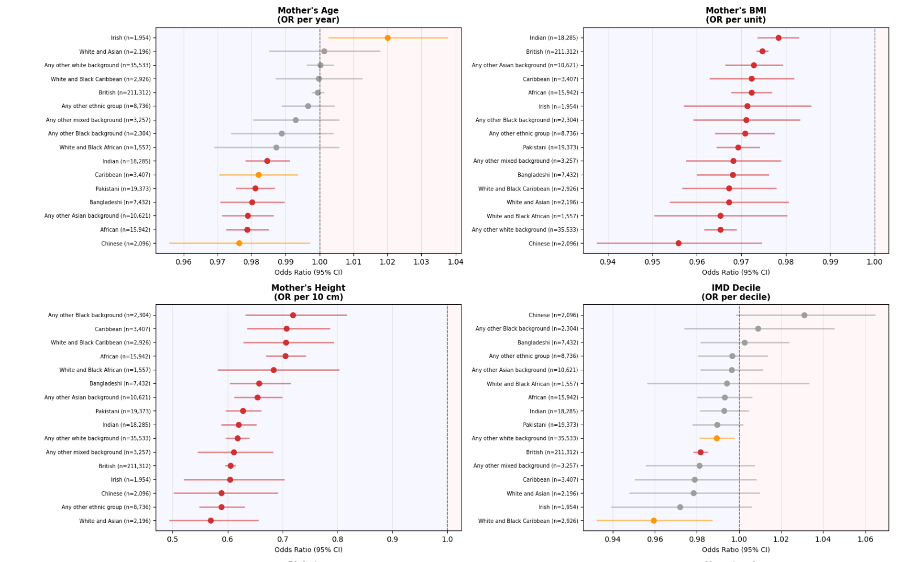
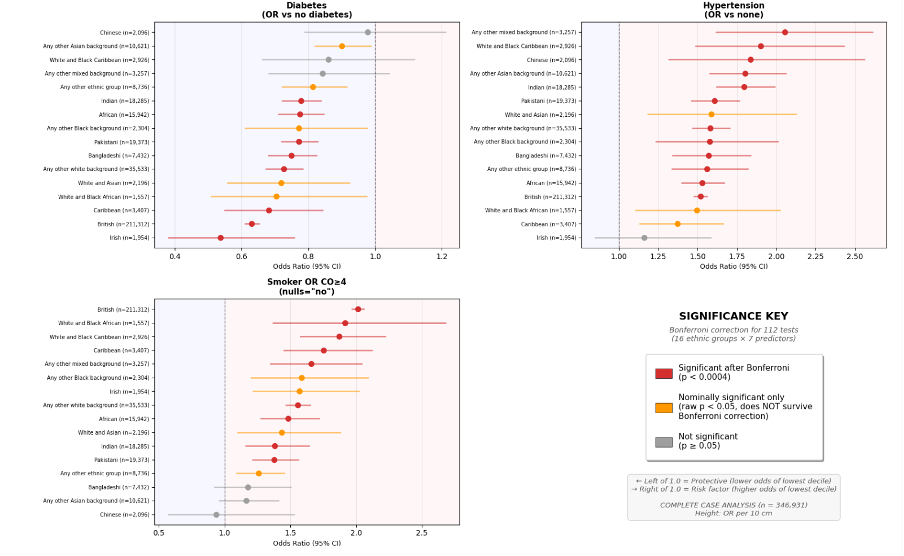
Figure 1. Adjusted associations between maternal factors and membership in the lowest birthweight decile, by maternal ethnic subcategory. Adjusted ORs compare membership in the lowest birthweight decile with membership in the fifth decile. ORs above 1 indicate higher odds of membership in the lowest decile, while ORs below 1 indicate lower odds. Red estimates remained significant after Bonferroni correction (p<0.000446), orange estimates were significant at the nominal 5% level only, and grey estimates were not statistically significant. Maternal height ORs are reported per 10 cm increase; other continuous predictors are reported per unit increase.
The results showed that gestational age was by far the strongest determinant of birthweight, but ethnicity remained independently associated with birthweight after accounting for other factors. Importantly, the factors associated with SGA were not uniform across ethnic groups. Smoking or elevated carbon monoxide showed particularly strong associations among White British, Caribbean and some mixed-ethnicity groups, whereas hypertensive disorders showed comparatively stronger associations in several South Asian, Chinese and mixed-background groups. These findings suggest that understanding how risk factors vary across populations may help support more appropriately targeted antenatal risk assessment and prevention strategies, rather than assuming that the same risk factors have the same importance for every population.